

Table of Contents
- Why a Private Ensuite Bathroom Changes the Glamping Experience
- The Glamping Amenities Checklist: What Separates Luxury from Basic
- What to Look for in a Luxury Glamping Site Before You Book
- Geodesic Domes vs Traditional Glamping Tents: What’s Different
- Year-Round Comfort: Climate Control and Insulation in Geodomes
- Privacy, Seclusion, and Romantic Getaway Considerations
- Proximity to Local Attractions and Outdoor Activities
- Why a Private Ensuite Bathroom Changes the Glamping Experience
- The Glamping Amenities Checklist: What Separates Luxury from Basic
- What to Look for in a Luxury Glamping Site Before You Book
- Geodesic Domes vs Traditional Glamping Tents: What’s Different
- Climate Control and Insulation in Geodomes
- Privacy, Seclusion, and Romantic Getaway Considerations
- Proximity to Local Attractions and Outdoor Activities
- Frequently Asked Questions
Last Updated: September 10, 2026
Why a Private Ensuite Bathroom Changes the Glamping Experience
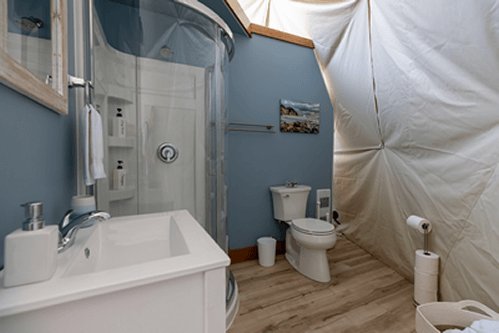
A private ensuite bathroom is the single feature that separates luxury glamping from a well-dressed tent: running water, a flush toilet, a hot shower, and a locking door inside your own unit.
An ensuite removes the two things people dread most about camping: the midnight walk to a shared washroom and the morning shower queue. At Northeast Cove Geodomes, each of the four private geodomes includes a private ensuite bathroom.
The Glamping Amenities Checklist: What Separates Luxury from Basic
A useful glamping amenities checklist sorts properties by what is inside the unit, not what the marketing promises. Four categories do most of the work: the bathroom, the kitchen, the climate system, and the sleeping setup. Vagueness on any of them is usually the answer.
Ensuite Bathroom Essentials
The bathroom is where the luxury claim either holds up or collapses. Look for a private washroom with running water, a proper shower, a flush toilet, and a sink inside your unit. Anything described as a “shared facility” or a “short walk away” belongs in the basic tier.
Kitchenette and Climate Control Features
A kitchenette changes how you eat: with a sink, mini-fridge, and prep space, you can make coffee at sunrise without driving anywhere. Climate control is the other non-negotiable, since coastal temperatures drop after dark. Ask directly how the unit stays warm, not whether it has “climate control” on a spec sheet.
What to Look for in a Luxury Glamping Site Before You Book
What to look for in a luxury glamping site comes down to four things: a private ensuite, genuine climate control, a kitchenette, and honest information about access and connectivity. A property that publishes clear details about its bathrooms, heating, and kitchen facilities is usually confident about what it offers; one that leans on scenery alone is worth a second look.
Accessibility and Connectivity Considerations
Accessibility is the detail most glamping guides skip. If you have mobility concerns, ask about the path from parking to the dome, the doorway width, and whether the bathroom has step-free entry.
Connectivity is the other practical gap. Ask whether the property has Wi-Fi and how strong the cell signal is. Some guests want to disconnect; others need to check in with family. Know which experience you are booking.
Sustainability Practices That Matter
Eco-luxury is a widely used term, so ask what a property actually does. Off-grid systems, water conservation, waste reduction, and locally sourced furnishings are worth asking about. A geodesic dome is inherently efficient because its shape uses less material and loses less heat than a comparable rectangular structure.
Geodesic Domes vs Traditional Glamping Tents: What’s Different
A geodesic dome is a spherical structure built from triangular panels connected at nodes (britannica.com). That geometry distributes structural load across the whole shell rather than concentrating it at poles and guy lines, which is why a dome holds its shape in wind that would flatten a canvas tent of similar footprint. The same triangulation creates a continuous curved interior with no sloped walls, so a dome feels like a room rather than a shelter.
Traditional glamping tents win on nostalgia and open-air feel, a safari-style canvas tent with a raised platform and wood stove is often the more atmospheric choice for warm-weather stays. Domes win on space, weather resistance, and stable indoor temperature, and they accommodate features a canvas tent struggles with: a full ensuite bathroom, a kitchenette, and panoramic windows for stargazing from bed.
The practical differences come down to five mechanisms:
- Interior volume. A dome’s curved shell gives usable headroom across the full floor plan; a tent’s sloped walls push standing room to the center.
- Weather resistance. A rigid frame with a sealed shell sheds rain and wind without the sagging and seam stress canvas develops over a season.
- Thermal performance. A dome’s lower surface-area-to-volume ratio means less heat escapes per square foot of floor (energy.gov).
- Plumbing. Running water, a flush toilet, and a shower require a structure that can carry the weight and moisture. Domes handle this routinely; canvas tents rarely do.
- Stargazing. A panoramic window in a dome’s upper shell gives you an unobstructed view of the night sky from bed; tent mesh panels are smaller and often at eye level.
Feature | Geodesic Dome | Traditional Glamping Tent |
|---|---|---|
Interior space | High, vertical volume across the floor plan | Lower, sloped walls limit standing room |
Weather resistance | Rigid frame, sealed shell | Depends on canvas tension and seam condition |
Ensuite bathroom | Common | Rare |
Climate control | Effective, aided by low surface-area-to-volume ratio | Limited, reliant on stove or space heater |
Stargazing window | Large, panoramic, often overhead | Smaller, often mesh at eye level |
Setup and siting | Requires a level pad and anchoring | More flexible on uneven ground |
Best for | Year-round comfort and ensuite amenities | Warm-weather stays and open-air atmosphere |
The honest trade-off: domes need a level pad and proper anchoring, which limits siting, while tents are more forgiving on uneven ground. If your priority is a private ensuite, real climate control, and a view of the stars from bed, the dome is built for it. If it is sleeping with the canvas open to the breeze in July, the tent still wins.
Connectivity: The Question Most Glamping Guides Skip
“Off-grid” and “no signal” are not the same thing. A property can run on solar and a well with no municipal hookups and still offer high-speed Wi-Fi via satellite, while another can have full grid power and a dead cell zone (fcc.gov).
Before booking, ask three questions: Is there Wi-Fi in the unit, and what is the typical speed? Which cell carriers get reliable signal at the site? Is there a backup connection if the primary one drops? Digital nomads who need video calls should treat a vague answer as a no; guests who want to disconnect should confirm the unit genuinely has no signal. luxury outdoor lounge.
Accessibility: The Detail Most Guides Leave Out
Accessibility is the gap in nearly every glamping guide, and it matters most for the guests who need it. A dome on a waterfront slope can be comfortable and still unreachable for someone using a wheelchair or recovering from surgery.
Ask about the path from parking to the unit: is it paved, gravel, or uneven ground? Is there a step up to the deck, and how high? Is the bathroom doorway wide enough for a walker or wheelchair, and does the shower have step-free entry? A property that answers precisely has thought about access. For guests with mobility concerns, request the unit closest to parking, confirm the path surface in writing, and ask for a photo of the entry and bathroom.
Year-Round Comfort: Climate Control and Insulation in Geodomes
Year-round comfort in a geodome depends on three things working together: the insulation of the shell, the sizing of the heating and cooling system, and the air-sealing of the base and seams. The shape helps, a dome’s low surface-area-to-volume ratio means less heat escapes per square foot, but shape alone does not make a dome warm. A single-skin shell over a frame performs much closer to a tent than the photos suggest.
Here is what actually determines whether a dome stays comfortable in a cold snap:
- Shell construction. Insulated panels or a double-layer shell with an air gap hold warmth far better than a single skin. Ask what the shell is made of, not just whether it is “insulated.”
- Base sealing. The ring where the dome meets its platform is the most common place for cold air to enter; a sealed base ring with no gaps marks a well-built unit.
- Heating system sizing. A properly sized system runs continuously at low output rather than blasting on and off. Undersized heaters struggle on the coldest nights; oversized ones cycle uncomfortably.
- Ventilation. A sealed dome needs controlled air exchange to manage condensation and humidity, look for a vent or heat-recovery system.
- Floor insulation. A cold floor radiates cold upward; an insulated platform or heated floor makes a bigger difference than most guests expect.
The honest caveat: not every dome is built to the same standard. Ask how the unit is insulated and whether heating runs continuously or on a timer. A dome with real climate control stays comfortable when coastal nights turn sharp; one without it is a tent with better geometry.
What to Ask Before You Book a Cold-Weather Stay
A short, specific list of questions separates a confident operator from a vague one:
- What is the shell made of, and is it insulated?
- What heating system is in the unit, and what temperature can it hold on a night near freezing?
- Is there air conditioning for summer afternoons?
- Is the floor insulated?
- Does the unit have a vent or humidity control?
- Is there a backup heat source if the primary one fails?
A property that answers these precisely has invested in the build; one that deflects is worth a second look.
Seasonal Patterns to Expect
Shoulder seasons, spring and fall, are often the best time to visit a well-built dome: mild days, thinner crowds, and climate control that earns its keep at night. Summer afternoons can push interior temperatures up in a dome with large windows, which is why air conditioning matters more than most guests expect. Winter stays are the real test of a build: a properly insulated and heated dome handles them comfortably, and a marginal one does not.
Privacy, Seclusion, and Romantic Getaway Considerations
Privacy is the question couples ask most, and the answer comes down to spacing and unit count. A property with a small number of well-separated units delivers a genuinely secluded stay. A large resort-style site with dozens of closely packed tents does not, regardless of how private each unit looks in the photos.
Ask how far apart the units sit and how many guests the property hosts at once. A site limited to a handful of domes for one or two guests each keeps noise low and sightlines clear, that layout makes a romantic getaway feel like a retreat instead of a campground with better bedding.
Proximity to Local Attractions and Outdoor Activities
Proximity to local attractions shapes how you spend your days, and the best glamping locations put outdoor activities within easy reach. Waterfront properties that include complimentary kayaks, paddleboards, and bikes remove the logistics problem entirely: no rental bookings, no gear to haul.
That inclusion is worth verifying, because “activities available” and “activities included” are different promises. A property that provides the equipment on site lets you paddle in the morning and hike in the afternoon without planning either in advance. Staying close to a scenic trail network and a small coastal community also means local food, local art, and a genuine sense of place.
Why a Private Ensuite Bathroom Changes the Glamping Experience
A private ensuite bathroom is the single feature that separates luxury glamping from a well-dressed tent: running water, a flush toilet, a hot shower, and a locking door inside your own unit.
An ensuite removes the two things people dread most about camping: the midnight walk to a shared washroom and the morning shower queue. At Northeast Cove Geodomes, each of the four private geodomes includes a private ensuite bathroom.
The Glamping Amenities Checklist: What Separates Luxury from Basic
A useful glamping amenities checklist sorts properties by what is inside the unit, not what the marketing promises. Four categories do most of the work: the bathroom, the kitchen, the climate system, and the sleeping setup. Vagueness on any of them is usually the answer.
Ensuite Bathroom Essentials
The bathroom is where the luxury claim either holds up or collapses. Look for a private washroom with running water, a proper shower, a flush toilet, and a sink inside your unit. Anything described as a “shared facility” or a “short walk away” belongs in the basic tier.
Kitchenette and Climate Control Features
A kitchenette changes how you eat: with a sink, mini-fridge, and prep space, you can make coffee at sunrise without driving anywhere. Climate control is the other non-negotiable, since coastal temperatures drop after dark. Ask directly how the unit stays warm, not whether it has “climate control” on a spec sheet.
Tip: When comparing listings, ask one specific question: “Is the bathroom inside my unit, and does it have running water?” The answer tells you more about the comfort level than any photo of a bed.
What to Look for in a Luxury Glamping Site Before You Book
What to look for in a luxury glamping site comes down to four things: a private ensuite, genuine climate control, a kitchenette, and honest information about access and connectivity. A property that publishes clear details about its bathrooms, heating, and kitchen facilities is usually confident about what it offers; one that leans on scenery alone is worth a second look.
Accessibility and Connectivity Considerations
Accessibility is the detail most glamping guides skip. If you have mobility concerns, ask about the path from parking to the dome, the doorway width, and whether the bathroom has step-free entry.
Connectivity is the other practical gap. Ask whether the property has Wi-Fi and how strong the cell signal is. Some guests want to disconnect; others need to check in with family. Know which experience you are booking.
Sustainability Practices That Matter
Eco-luxury is a widely used term, so ask what a property actually does. Off-grid systems, water conservation, waste reduction, and locally sourced furnishings are worth asking about. A geodesic dome is inherently efficient because its shape uses less material and loses less heat than a comparable rectangular structure.
Geodesic Domes vs Traditional Glamping Tents: What’s Different
A geodesic dome is a spherical structure built from triangular panels connected at nodes. That geometry distributes structural load across the whole shell rather than concentrating it at poles and guy lines, which is why a dome holds its shape in wind that would flatten a canvas tent of similar footprint. The same triangulation creates a continuous curved interior with no sloped walls, so a dome feels like a room rather than a shelter.
Traditional glamping tents win on nostalgia and open-air feel, a safari-style canvas tent with a raised platform and wood stove is often the more atmospheric choice for warm-weather stays. Domes win on space, weather resistance, and stable indoor temperature, and they accommodate features a canvas tent struggles with: a full ensuite bathroom, a kitchenette, and panoramic windows for stargazing from bed.
The practical differences come down to five mechanisms:
- Interior volume. A dome’s curved shell gives usable headroom across the full floor plan; a tent’s sloped walls push standing room to the center.
- Weather resistance. A rigid frame with a sealed shell sheds rain and wind without the sagging and seam stress canvas develops over a season.
- Thermal performance. A dome’s lower surface-area-to-volume ratio means less heat escapes per square foot of floor.
- Plumbing. Running water, a flush toilet, and a shower require a structure that can carry the weight and moisture. Domes handle this routinely; canvas tents rarely do.
- Stargazing. A panoramic window in a dome’s upper shell gives you an unobstructed view of the night sky from bed; tent mesh panels are smaller and often at eye level.
Feature | Geodesic Dome | Traditional Glamping Tent |
|---|---|---|
Interior space | High, vertical volume across the floor plan | Lower, sloped walls limit standing room |
Weather resistance | Rigid frame, sealed shell | Depends on canvas tension and seam condition |
Ensuite bathroom | Common | Rare |
Climate control | Effective, aided by low surface-area-to-volume ratio | Limited, reliant on stove or space heater |
Stargazing window | Large, panoramic, often overhead | Smaller, often mesh at eye level |
Setup and siting | Requires a level pad and anchoring | More flexible on uneven ground |
Best for | Year-round comfort and ensuite amenities | Warm-weather stays and open-air atmosphere |
The honest trade-off: domes need a level pad and proper anchoring, which limits siting, while tents are more forgiving on uneven ground. If your priority is a private ensuite, real climate control, and a view of the stars from bed, the dome is built for it. If it is sleeping with the canvas open to the breeze in July, the tent still wins.
Tip: When a listing says “dome,” ask what the shell is made of and how the panels are sealed. A well-built dome uses insulated panels or a double-layer shell with a sealed base ring; a cheap one is a single-skin shell over a frame, which performs much closer to a tent than the photos suggest.
Connectivity: The Question Most Glamping Guides Skip
“Off-grid” and “no signal” are not the same thing. A property can run on solar and a well with no municipal hookups and still offer high-speed Wi-Fi via satellite, while another can have full grid power and a dead cell zone.
Before booking, ask three questions: Is there Wi-Fi in the unit, and what is the typical speed? Which cell carriers get reliable signal at the site? Is there a backup connection if the primary one drops? Digital nomads who need video calls should treat a vague answer as a no; guests who want to disconnect should confirm the unit genuinely has no signal.
Accessibility: The Detail Most Guides Leave Out
Accessibility is the gap in nearly every glamping guide, and it matters most for the guests who need it. A dome on a waterfront slope can be comfortable and still unreachable for someone using a wheelchair or recovering from surgery.
Ask about the path from parking to the unit: is it paved, gravel, or uneven ground? Is there a step up to the deck, and how high? Is the bathroom doorway wide enough for a walker or wheelchair, and does the shower have step-free entry? A property that answers precisely has thought about access. For guests with mobility concerns, request the unit closest to parking, confirm the path surface in writing, and ask for a photo of the entry and bathroom.
Climate Control and Insulation in Geodomes
Year-round comfort in a geodome depends on three things working together: the insulation of the shell, the sizing of the heating and cooling system, and the air-sealing of the base and seams. The shape helps, a dome’s low surface-area-to-volume ratio means less heat escapes per square foot, but shape alone does not make a dome warm. A single-skin shell over a frame performs much closer to a tent than the photos suggest.
Here is what actually determines whether a dome stays comfortable in a cold snap:
- Shell construction. Insulated panels or a double-layer shell with an air gap hold warmth far better than a single skin. Ask what the shell is made of, not just whether it is “insulated.”
- Base sealing. The ring where the dome meets its platform is the most common place for cold air to enter; a sealed base ring with no gaps marks a well-built unit.
- Heating system sizing. A properly sized system runs continuously at low output rather than blasting on and off. Undersized heaters struggle on the coldest nights; oversized ones cycle uncomfortably.
- Ventilation. A sealed dome needs controlled air exchange to manage condensation and humidity, look for a vent or heat-recovery system.
- Floor insulation. A cold floor radiates cold upward; an insulated platform or heated floor makes a bigger difference than most guests expect.
The honest caveat: not every dome is built to the same standard. Ask how the unit is insulated and whether heating runs continuously or on a timer. A dome with real climate control stays comfortable when coastal nights turn sharp; one without it is a tent with better geometry.
What to Ask Before You Book a Cold-Weather Stay
A short, specific list of questions separates a confident operator from a vague one:
- What is the shell made of, and is it insulated?
- What heating system is in the unit, and what temperature can it hold on a night near freezing?
- Is there air conditioning for summer afternoons?
- Is the floor insulated?
- Does the unit have a vent or humidity control?
- Is there a backup heat source if the primary one fails?
A property that answers these precisely has invested in the build; one that deflects is worth a second look.
Seasonal Patterns to Expect
Shoulder seasons, spring and fall, are often the best time to visit a well-built dome: mild days, thinner crowds, and climate control that earns its keep at night. Summer afternoons can push interior temperatures up in a dome with large windows, which is why air conditioning matters more than most guests expect. At Northeast Cove Geodomes, the season runs May through October, so shoulder-season comfort matters at both ends of a stay, not just in the depths of winter: a properly insulated and heated dome handles a cool May or October night comfortably, and a marginal one does not.
Warning: Do not assume “climate control” means the same thing at every property. Some listings mean a space heater and a blanket. Ask for specifics on the heating system, the insulation, and the floor before you commit, especially for spring and fall stays.
Takeaway: The features that define luxury glamping with private bathroom are concrete: an ensuite with running water, real climate control, a kitchenette, a private deck, and included outdoor gear. Confirm each one directly before booking.
Privacy, Seclusion, and Romantic Getaway Considerations
Privacy is the question couples ask most, and the answer comes down to spacing and unit count. A property with a small number of well-separated units delivers a genuinely secluded stay. A large resort-style site with dozens of closely packed tents does not, regardless of how private each unit looks in the photos.
Ask how far apart the units sit and how many guests the property hosts at once. A site limited to a handful of domes for one or two guests each keeps noise low and sightlines clear, that layout makes a romantic getaway feel like a retreat instead of a campground with better bedding.
Proximity to Local Attractions and Outdoor Activities
Proximity to local attractions shapes how you spend your days, and the best glamping locations put outdoor activities within easy reach. Waterfront properties that include complimentary kayaks, paddleboards, and bikes remove the logistics problem entirely: no rental bookings, no gear to haul.
That inclusion is worth verifying, because “activities available” and “activities included” are different promises. A property that provides the equipment on site lets you paddle in the morning and hike in the afternoon without planning either in advance. Staying close to a scenic trail network and a small coastal community also means local food, local art, and a genuine sense of place.
Takeaway: Proximity is worth verifying the same way comfort claims are: ask what is actually included versus merely nearby. A property with complimentary kayaks, paddleboards, and bikes, and real trails or water access close by, removes the planning burden entirely.
The hard part of booking glamping is not finding a pretty dome; it is confirming that the comfort claims are real. Northeast Cove Geodomes was built around exactly that gap, with four private geodomes for one or two guests, each featuring a private ensuite bathroom, a fully equipped kitchenette, and climate control (heating and air conditioning) that holds up through the property’s May-through-October season. Complimentary kayaks, paddleboards, and bikes are included, along with hotel-quality linens and original local artwork. Book now with Northeast Cove Geodomes and settle into a waterfront stay where the bathroom is inside, the heat works, and the only thing left to plan is which trail to take first.
Frequently Asked Questions
Is a private ensuite bathroom standard in luxury glamping?
Not always. True luxury glamping with private bathroom facilities is a defining feature, but some sites still use shared washroom blocks. Before booking, check the listing for terms like ‘ensuite,’ ‘private washroom,’ or ‘attached bathroom.’ If the description says ‘shared facilities’ or ‘communal washhouse,’ it is not a private setup. Reputable glamping resorts list this clearly because it is one of the top deciding factors for guests.
How do I verify a glamping site actually has a private bathroom before booking?
Look for photo evidence of the bathroom interior, not just the bedroom. Read recent guest reviews specifically mentioning the ensuite, running water, or private washroom. Check the amenities checklist on the site’s booking page. If the listing is vague, contact the host directly and ask whether the bathroom is inside your unit or in a separate building. A quick email saves disappointment on arrival.
What should I pack for a luxury glamping trip with private facilities?
Even with an ensuite bathroom and kitchenette, bring personal toiletries, comfortable indoor footwear, and layers for cooler evenings. Most luxury sites provide hotel-quality linens, towels, and basic cookware. Check whether the kitchenette includes a mini-fridge, kettle, and dishes. If you plan to stargaze or use a fire pit, pack a warm jacket and insect repellent for shoulder seasons. Confirm what is included so you do not overpack.
How does climate control impact comfort in a geodome during shoulder seasons?
A geodome with proper insulation and climate control stays comfortable well into spring and fall. Look for listings that mention heating, air conditioning, or a gas fireplace. Some domes also include heated floors or extra blankets. If you run cold easily, ask the host how the unit performs in cooler months. Guest reviews often mention whether the dome stayed warm overnight, which is a reliable indicator.


